From Reactive SOC to Preemptive Security Operations: Why the AI SOC Model Must Evolve

Blog

From Reactive SOC to Preemptive Security Operations: Why the AI SOC Model Must Evolve

Nitin Agale
Founder and CEO
For years, security operations have been optimized around one core function: responding to alerts. SIEMs generate alerts. SOCs triage them. MDR providers investigate and close tickets. Success is measured in mean time to respond, tickets resolved, and alerts handled per analyst. But this model is reaching its limits.
Table of Contents

As environments grow more distributed, data becomes more fragmented, and adversaries move faster, security teams are drowning in alerts while still missing real threats. The problem isn’t a lack of tools or people. It’s that the underlying SOC model is still fundamentally reactive.

The Limits of Reactive Security Operations

Traditional SOCs were designed for a world where data was centralized, threats moved more slowly, and manual investigation could keep pace. That world no longer exists.

Today’s security teams face exploding alert volumes, federated data spread across cloud platforms, SaaS, endpoints, and identity systems, and adversaries exploiting gaps faster than humans can investigate. The result is a paradox: teams are busier than ever, yet security posture doesn’t materially improve.

Most SOC effort is spent triaging false positives, closing duplicate alerts, and investigating symptoms rather than fixing root causes. Even modern MDR services largely inherit this model. They replace in-house analysts with outsourced ones, but still operate on the same alert-driven, ticket-based workflow. The work gets done somewhere else, but the underlying security posture remains unchanged.

AI SOC Isn’t Just About Faster Response

AI entered security operations promising speed and efficiency. Faster investigations. Automated triage. Reduced toil.

These are meaningful improvements, but they are not enough.

If AI is only used to accelerate reactive workflows, security teams still end up responding after something has already gone wrong. Faster response is better than slow response, but it doesn’t fundamentally change the nature of the problem.

Why Architecture Matters

Preemptive security also requires rethinking architecture.

Many SOC models assume centralized data and a single SIEM as the source of truth. In reality, data increasingly lives across federated systems. Pulling everything into one place is expensive, slow, and often unnecessary.

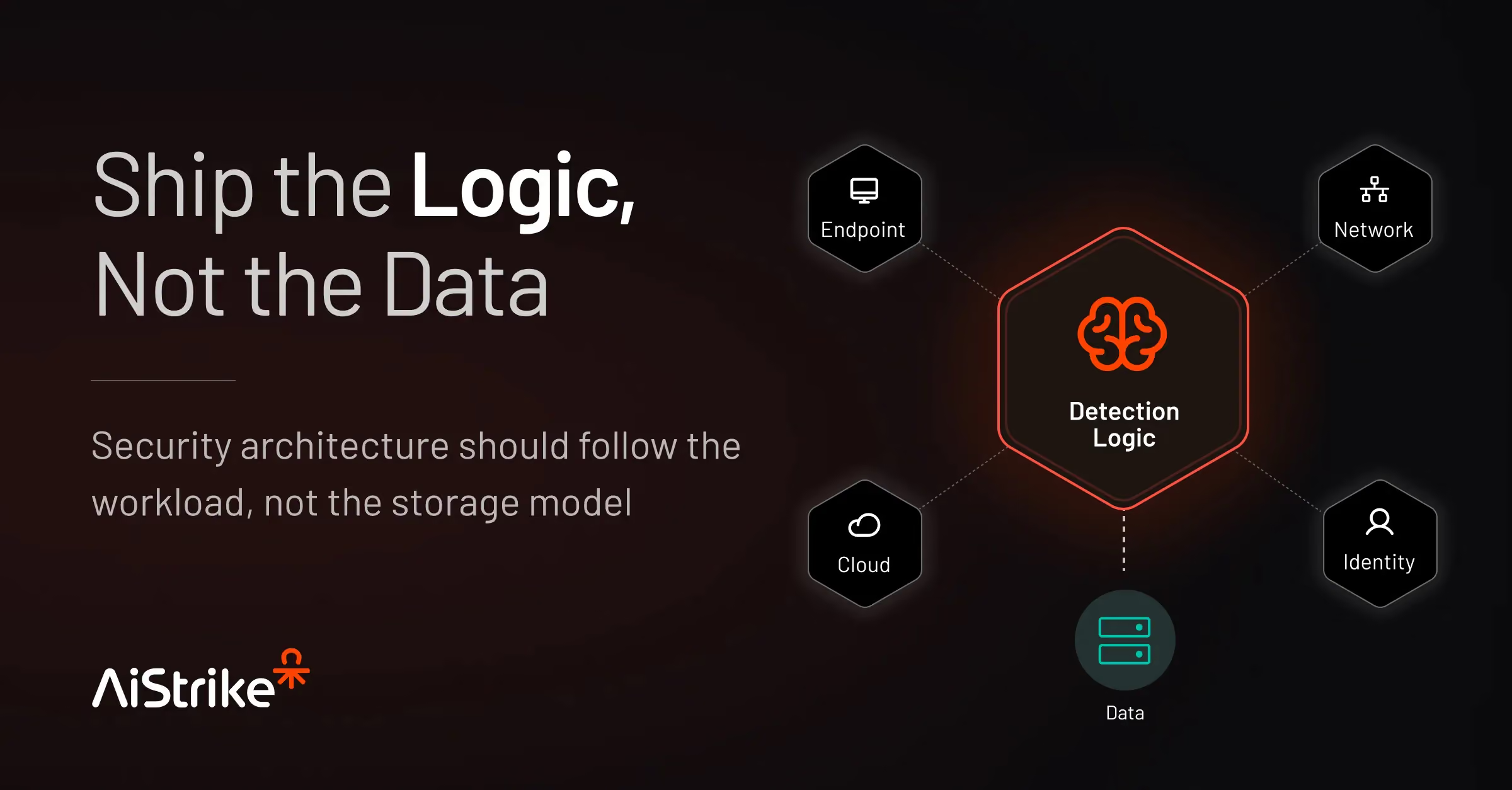
A modern AI SOC must be able to run detections where data lives, correlate signals across federated sources, and improve detection quality without forcing rigid data movement. This flexibility is essential to scaling security operations without increasing cost or complexity.

Humans Still Matter - Just Not for Busy Work

Preemptive security does not remove humans from the loop. It changes where human expertise is applied.

Instead of spending time closing tickets, reinvestigating known false positives, and manually tuning rules, security teams can focus on improving detection strategies, validating high-confidence threats, and making informed risk decisions. AI handles the repetitive, mechanical work, while humans guide strategy, context, and judgment.

The real opportunity with AI is not just to respond faster, but to prevent incidents by continuously improving security posture. That requires rethinking what a SOC is responsible for.

From Alerts to Detection Quality

In a reactive SOC model, alerts are treated as the primary unit of work. In a preemptive model, detections themselves become the primary asset.

Instead of asking how quickly an alert can be investigated, security teams should be asking why the alert existed in the first place, what detection gap allowed the activity to go unnoticed, and what signals are missing across the environment.

AI makes it possible to continuously analyze detection coverage, alert efficacy, and false-positive rates across environments. By identifying and fixing detection gaps proactively, organizations reduce alert noise and reduce risk at the same time.

Preemptive Security Operations Starts Earlier in the Attack Lifecycle

Reactive security focuses on what happens after suspicious activity is detected. Preemptive security focuses on what happens before that activity ever generates an alert.

This means continuously assessing exposure based on emerging threats and vulnerabilities, mapping those threats to organizational posture, prioritizing gaps attackers are most likely to exploit, and generating or tuning detections before incidents occur.

When security operations extend earlier in the attack lifecycle, teams stop chasing alerts and start preventing incidents.
Latest Resources

All Resources
Blog

From Reactive SOC to Preemptive Security Operations: Why the AI SOC Model Must Evolve

For years, security operations have been optimized around one core function: responding to alerts. SIEMs generate alerts. SOCs triage them. MDR providers investigate and close tickets. Success is measured in mean time to respond, tickets resolved, and alerts handled per analyst. But this model is reaching its limits.
Read More
Blog

Investigating millions of CSPM alerts — where do you even start?

I got this question last week from one of the largest financial institutions: “When you’re looking at millions of CSPM alerts, do you actually investigate them or just treat them as hygiene issues and assign them to the cloud team?” Honestly, it’s a fair question—and one a lot of teams are probably asking themselves.
Read More
Blog

Rethinking Alert Ownership in Security Ops

All alerts are not equal. Yet somehow, every alert becomes the SOC’s problem. Every day, SIEM and CNAPP tools flood the SOC with alerts — but take a closer look, and they generally fall into four categories:
Read More
Case study

How Sunrun Transformed Security Operations with AiStrike

Transforming to an AI-Powered Self-Improving SOC
Read More
Case study

Global Software Design Company Leverages AiStrike to Investigate Cloud Alerts

Global Software Design Company Leverages AiStrike to Investigate Cloud Alerts
Read More
News

Harsh Patwardhan Joins AiStrike as Chief Technology Officer

Reuniting a Proven Leadership Team to Build the Future of Autonomous Security Operations.
Read More
News

AiStrike Announces AI Agents for Detection Optimization, Advancing the Complete AI-Augmented SOC

San Francisco, CA – April 14, 2025 – AiStrike, the AI SOC automation platform transforming cybersecurity operations, today announced the launch of its AI Agents for Detection Optimization—a first-of-its-kind capability that helps security teams improve detection quality, eliminate blind spots, and reduce alert noise by automatically identifying coverage gaps and tuning detections in real time.
Read More
News

AiStrike Emerges from Stealth to Solve Cloud Security Investigation and Response using AI-powered Automation

Guidelines for selecting the most suitable CMS for your project.
Read More
News

Cloud Security Operations Leader AiStrike Launches AI-Powered Cloud Security Investigation and Response Solution on AWS Marketplace

Exploring the advantages of utilizing a CMS for website management.
Read More
News

Jhilmil Kochar Joins AiStrike as Chief Engineering and Product Leader

Former CrowdStrike Executive with over 30 years of experience in Cybersecurity and Product Development joins AiStrike, the startup redefining AI-Powered Security Automation.
Read More
Datasheets

AI-Powered Automation for Threat Investigation and Response

In today's landscape of relentless cyber-attacks, organizations are facing increasing threats to their critical assets. Security detection tools like SIEM, XDR, and CNAPP generate vast volumes of alerts—often lacking sufficient context—leaving security teams overwhelmed with alert backlog. With limited resources and insufficient business context, prioritizing critical alerts that require immediate action becomes a significant challenge.
Read More
Solution Briefs

AiStrike for AWS

Cloud infrastructure today is the primary target for malicious actors. The risk of exposure of cloud assets continues to grow as organizations expand their cloud footprint and new cyberattacks targeting cloud infrastructure emerge.
Read More
White Papers

CISO Guide: AI-Automated Cloud Security Operations

This guide provides CISOs with a comprehensive understanding of how AI-driven automation can revolutionize cloud security operations, enhancing both efficiency and effectiveness.
Read More
Blog

From Reactive SOC to Preemptive Security Operations: Why the AI SOC Model Must Evolve

For years, security operations have been optimized around one core function: responding to alerts. SIEMs generate alerts. SOCs triage them. MDR providers investigate and close tickets. Success is measured in mean time to respond, tickets resolved, and alerts handled per analyst. But this model is reaching its limits.
Read More
Blog

Investigating millions of CSPM alerts — where do you even start?

I got this question last week from one of the largest financial institutions: “When you’re looking at millions of CSPM alerts, do you actually investigate them or just treat them as hygiene issues and assign them to the cloud team?” Honestly, it’s a fair question—and one a lot of teams are probably asking themselves.
Read More
Blog

Rethinking Alert Ownership in Security Ops

All alerts are not equal. Yet somehow, every alert becomes the SOC’s problem. Every day, SIEM and CNAPP tools flood the SOC with alerts — but take a closer look, and they generally fall into four categories:
Read More