
Behavioral analytics can tell you what’s unusual. It can’t tell you what happened.
For years, User and Entity Behavior Analytics has been the technology foundation for insider-threat programs. The premise makes sense: baseline users and entities, identify deviations from normal, correlate suspicious signals, assign risk.
But insider threat has a problem that behavioral scoring alone cannot solve.
An anomaly is not an insider threat. It is the beginning of an investigation.
A user accessing a sensitive repository after hours is unusual. So is an administrator touching a production system for the first time, or an employee downloading far more data than their peers. Each could be benign. Each could be malicious.
The question isn’t “is this unusual?” It’s “what actually happened?”
The anomaly queue became another alert queue
Legacy UEBA was built to reduce an overwhelming volume of security events down to the behavioral anomalies worth investigating. But the output is still an anomaly, a risk score, an alert.
The analyst then has to work out why it happened, whether other activity is related, what systems and data were involved, whether this is legitimate work or malicious intent, and what to do next. At enterprise scale, behavioral analytics becomes another queue requiring human investigation — recreating the operational problem it was bought to solve.
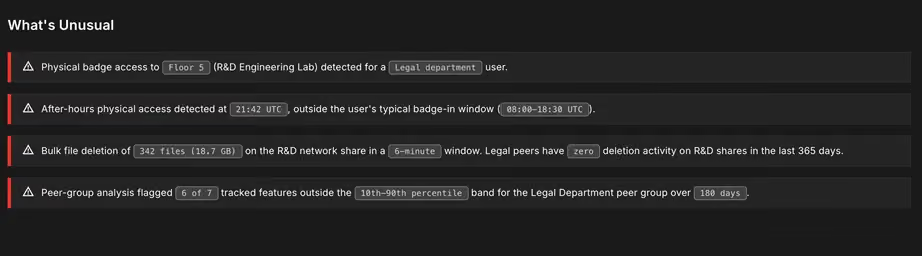
Insider threats make this harder, because the individual actions usually look legitimate. Consider an employee who badges into an R&D facility outside normal hours, accesses a restricted engineering share, performs unusual system discovery, then deletes hundreds of files.
Individually, none of those establishes intent. Together, they tell a very different story.
Legacy UEBA follows a fixed path. Investigations shouldn’t.
Traditional UEBA correlates signals using predefined behavioral models, thresholds, rules and patterns. Similar signals with similar attributes follow the same analytical path. But investigations aren’t deterministic — what you look at next depends on what you just found.
Suppose two employees generate nearly identical alerts for unusual access to a sensitive repository.
The starting signals are the same. The investigations shouldn’t be.
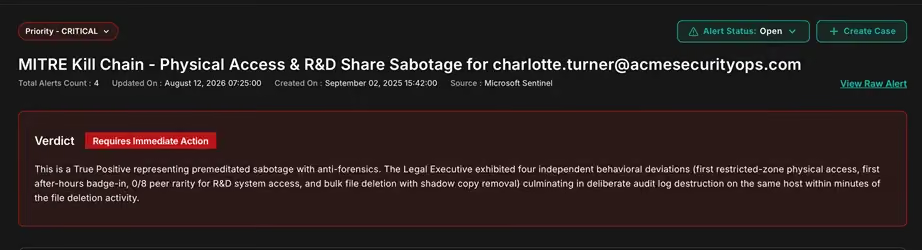
AiStrike forms hypotheses, collects evidence, and decides what to examine next based on what it finds. The path is driven by the evidence, not by a workflow written in advance. It reasons across physical access, historical behavior, peer activity, production-system access and what the user did afterward as one investigation — rather than presenting four disconnected anomalies and leaving the analyst to join them.
Behavior analytics should be the beginning, not the end
AiStrike doesn’t replace behavioral analytics. It makes behavioral analytics the first step in a larger operating model.
Once suspicious behavior is identified, AiStrike gathers and correlates evidence across identity, endpoint, cloud, physical access, DLP and applications — and asks the questions an experienced insider-threat analyst would ask. Was this normal for this user? For their peers? What happened immediately before and after? Did physical and digital behavior align? What sensitive systems or data were involved? Was there subsequent staging, deletion or concealment?
Behavior analytics finds the anomaly. Investigation determines what it means.
Stop moving all the data just to understand the user
Legacy standalone UEBA inherits an assumption from traditional SIEM: centralize the events before analyzing them. That means duplicating data already sitting in the SIEM or enterprise data platform — and often duplicating the alerts and analytics along with it.
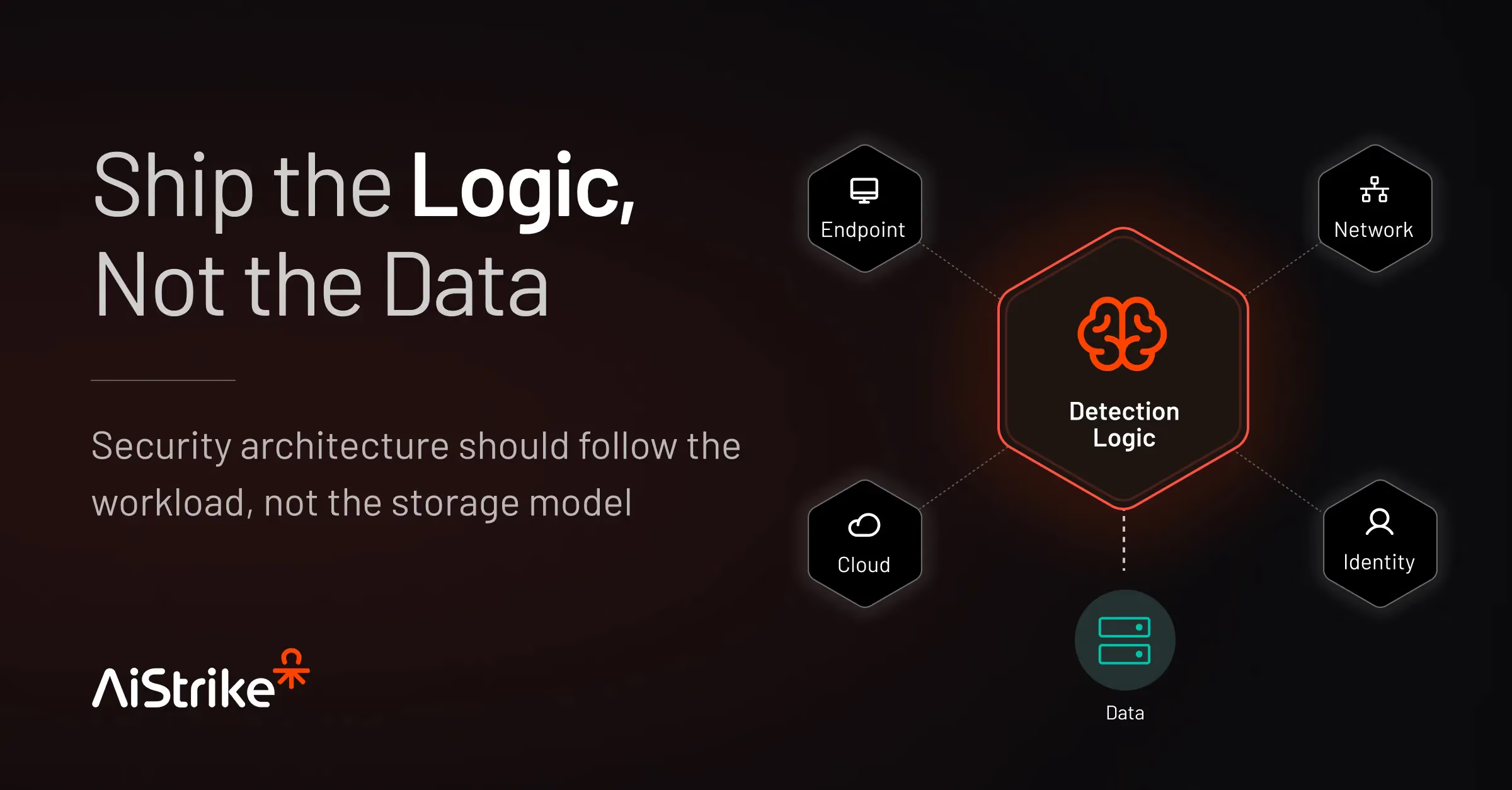
AiStrike runs on a federated architecture. Analytics and investigations operate across raw telemetry in existing SIEMs, security data lakes and open enterprise data stores, without requiring another centralized copy of all the data.
This matters for insider threat specifically, because the evidence never lives in one system. Identity is in IAM. Endpoint activity is in EDR. Sensitive-data activity is in DLP. Physical access is in a badge system. Application activity is in SaaS platforms. Business context is somewhere else entirely.
Bring the investigation to the data — not all the data to another investigation platform.
Hunt for the insider threat that never becomes an anomaly
There’s another blind spot in anomaly-centric security: what if no individual action looks unusual enough?
Sophisticated insider activity is low-and-slow. Each action stays inside expected thresholds while the pattern develops over days or weeks. Nothing ever crosses a line, so nothing is ever scored.
That’s why AiStrike pairs behavioral analytics with continuous threat hunting. Prepackaged insider-threat hunt packs search telemetry for multi-stage behaviors and suspicious patterns, rather than waiting for a single event to breach a threshold.
Don’t only investigate what the detection system tells you to investigate. Hunt for what it hasn’t detected yet.
UEBA is a capability. It shouldn’t be the whole architecture.
Behavioral analytics remains critical to insider-threat detection. But modern insider-threat operations need more: identity correlation, raw-telemetry analytics, threat hunting, investigation that adapts, evidence collection, enterprise context, case management and governed response.
That’s the evolution from legacy UEBA to AI-native insider-threat operations.
One question for your own program
Ask your insider threat team two things. How many anomalies did the platform produce last month? How many were investigated to a conclusion?
The gap between those two numbers is what you actually bought.
Legacy UEBA asks: is this unusual? AiStrike asks: what happened, is it a threat, and what should we do about it?

.avif)
.avif)
.avif)
.avif)
.avif)


.avif)
.avif)

.svg)
.webp)