

Two things actually broke.
The first is that reactive security was never a way to handle attacks. It was a way to handle exceptions — the incident with no playbook, the miss that justified a war room. That worked while the genuinely novel attack was rare. Frontier models made customized, adaptive attacks cheap enough that an unrecognizable attack pattern is now the ordinary case rather than the quarterly one. The model didn't degrade, its precondition disappeared.
The second is a threshold. The intervals between a vulnerability existing and being exploited and the killchain itself are collapsing. And somewhere inside that collapse sits human reaction time. Above the threshold, detect-and-respond works. Below it, the attack completes before a person can engage. That isn't a harder version of the same job — it's a phase change, and reaction doesn't become more difficult so much as it stops being a viable strategy. The analyst who drove every case through the process by hand becomes, necessarily, someone supervising a system that drives itself.
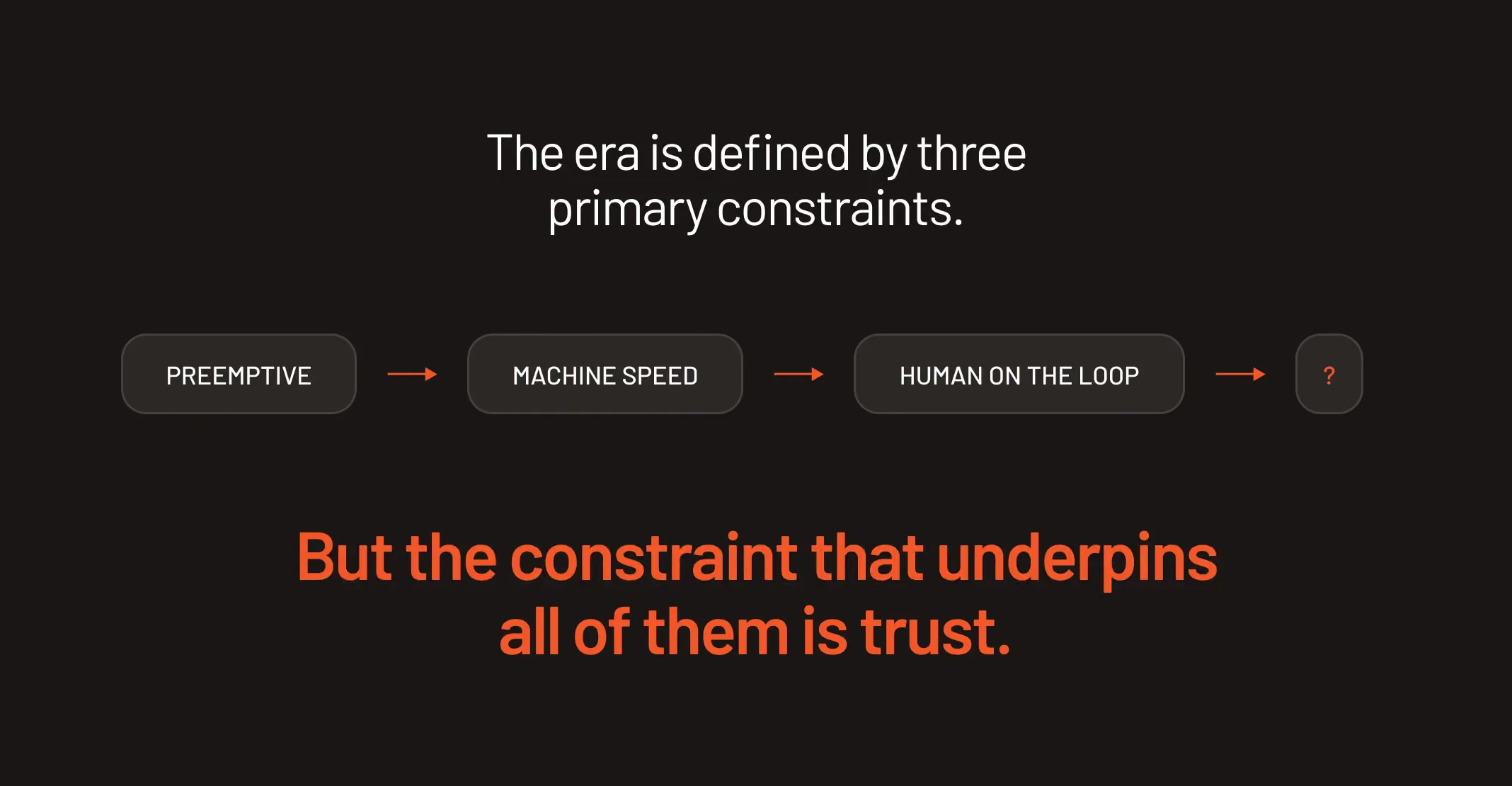
Preemptive is more than preventive
Prevention assumes you know what's coming. Reaction assumes you have time once it does. Neither assumption survives an adversary that composes something new on demand and moves faster than the people watching it.
What remains is preparation — continuously closing exposure, pre-positioning detection, shrinking blast radius, keeping response paths robust, all before any particular attack shows up. That's what preemptive means, and it's a superset of prevention rather than a more aggressive version of it.
It also moves the human from in the loop to on it — supervising the pattern of decisions rather than approving each one, since approving each one is the slow part. Which trades one problem for another. The binding constraint stops being can we move fast enough and becomes can we trust what's now moving on its own.
Trust was bundled. Now it isn't.
When an analyst owned this work, trust was a single judgment. You decided a person was good, and that one decision implicitly bought five separate assurances: that they would reason soundly, act proportionately, notice what nobody had asked them to look for, be as good next quarter as this one, and explain themselves afterward. Competence arrived as a bundle.
Distribute the same work across a hundred agents and the bundle comes apart. Each assurance becomes a distinct property, held by different components, failing in different ways, and verifiable only on its own terms. Here is one way to take them apart — five layers, each with a question that has to be answerable independently.
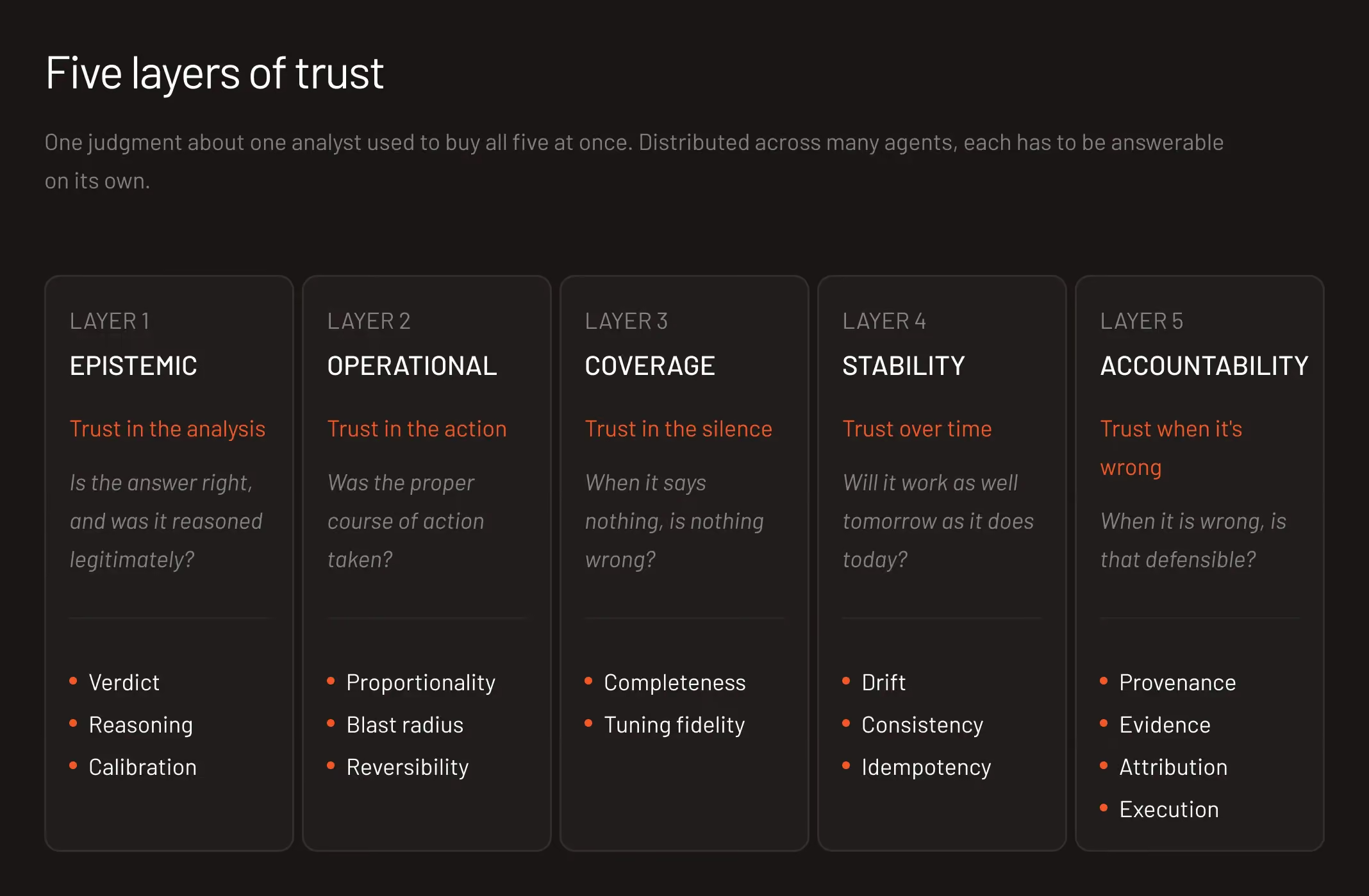
Epistemic — trust in the analysis. Is the answer right, and was it reasoned legitimately? Those are two questions, not one. A correct verdict reached by coincidence is a failure waiting for the first case that doesn't rhyme with the last. This layer covers the verdict, the reasoning path that produced it, and calibration — whether stated confidence tracks actual accuracy closely enough that "high confidence" is something you can act on.
Operational — trust in the action. Was the proper course of action taken? Being right about what happened and being right about what to do are different competencies, and the second is where the damage lives. It asks about proportionality — does the response match the severity — along with blast radius (what else this action touches) and reversibility (if it was wrong, can it be undone, and how fast).
Coverage — trust in the silence. When it says nothing, is nothing wrong? The layer almost nobody asks about, because silence doesn't announce itself. Every other layer is verified against output; this one is verified against absence. It covers completeness — what fraction of the ground is genuinely being watched — and tuning fidelity, whether the system's own adjustments have quietly narrowed what it is able to see.
Stability — trust over time. Will it work as well tomorrow as it does today? Environments move and models change, but the same input should produce the same disposition on Thursday that it did on Monday. Drift, consistency across equivalent cases, and idempotency — the same action taken twice shouldn't compound into something nobody intended.
Accountability — trust when it's wrong. When it is wrong, is that defensible? It will be wrong. The question is what can be reconstructed afterward: provenance for the data an answer rested on, evidence of why it concluded what it did, attribution of which component decided, and a record of what was actually executed rather than what was meant to be. This is the layer that gets ignored until a regulator, a board, or an insurer asks — and it can't be retrofitted, because the record either was kept or it wasn't.
The layers aren't independent. Accountability is what makes the others auditable; operational trust is un-earnable without epistemic trust beneath it. But the discipline worth keeping is to ask them separately, because a system can be excellent at four of the five and blind on the third — and the aggregate impression of competence will hide it.
Three horizons of autonomy
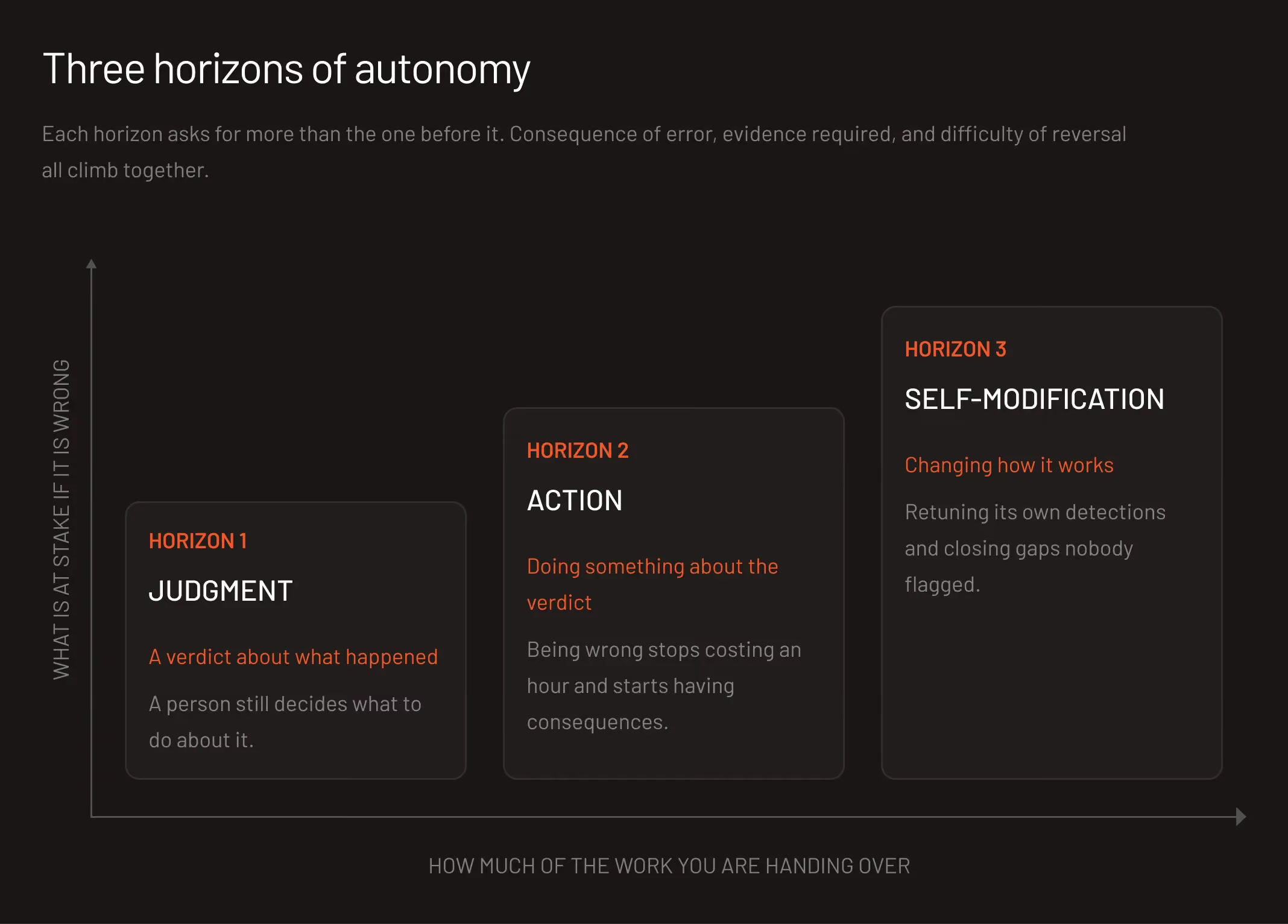
Alongside how well a system does something sits a second question: how much of the work you are handing over.
There are roughly three horizons. The first is judgment — a system's ability to reason and investigate, and the resulting verdict, with a person still deciding what to do about it. The second is action — the system doing something about that verdict, at which point being wrong stops costing an hour and starts having consequences. The third is self-modification — the system changing how it works, re-tuning its own detections and closing gaps nobody flagged.
The first horizon is largely settled. A system that reaches only that far is doing work the field has already learned how to do. The second is where most of the current effort sits, and most of the current hesitation with it. The third reads as distant, which is the wrong reading: execution has moved to machine speed while improvement stayed at human speed, and that arrangement doesn't hold. A system whose judgment is only as current as its last human tune-up is a fast system with a slow mind. It is a problem worth solving before it is needed rather than after.
The five layers are how that distance gets covered. Each horizon asks for more than the one before it, and the layers are where the answer has to come from — which is a longer subject than this piece can carry.
The least interesting things…
Most of what you get shown in an autonomous SOC pitch is capability — how much it handles, how little it needs you. Those demonstrations are real, and they're also the least durable thing about the product. Capability rides the model curve: much of what looks like a differentiator today is a property of the underlying models, and it will turn up in the systems you didn't buy on roughly the same schedule.
What doesn't improve on its own is the part underneath: semantic grounding, data quality, the evidence trail, provenance, calibration that has been measured rather than asserted. Nobody demos a schema. But that substrate is what determines whether a system can answer for itself, and unlike capability it can't be added later. A system that wasn't built to keep the record can't produce the record on the day you need it.
The harder problem is that there's no established way to ask about it. No convention for what calibration evidence looks like, no accepted way to demonstrate coverage, no standard for what a system should be able to reconstruct about a decision it got wrong. You are being asked to evaluate delegated judgment using a vocabulary built for features. That gap isn't yours alone to close, but it is yours to insist on — and five layers are one way to start asking.
Capability improves on its own. Credibility doesn't. And when the system is wrong, it is your organization that answers for it — which is why the one worth having isn't the one that does the most. It's the one you're finally willing to stop checking.

.avif)
.avif)
.avif)
.avif)
.avif)


.avif)
.avif)
.svg)
.webp)